


Showing posts with label Tips. Show all posts
 Electricity & Water
Indonesia runs 127V AC/50Hz but is in the process of converting to a 230V AC/50Hz. This conversion is complete in principal cities. Indonesia uses a type C,F, and G plug so North Americans travelling with electronics will need adapters.
It is not advisable to drink tap water in Indonesia, but bottled mineral water is safe and available everywhere. Ice in drinks is generally OK in good standard hotels and restaurants but it is best to avoid it on street stalls or in country areas.
Clothing
With temperatures ranging between 20-35�C, light, casual clothes are the most practical. Natural fibres like cotton or linen are the most comfortable in Indonesia's often humid conditions. Casual clothes are acceptable in most places and a lightweight suit and tie are usual for business or formal meetings. Light cotton dresses are generally acceptable in most situations. Batik is popular for both men's shirts and women's dresses.
Communications
Telephone
IDD is available to main cities. Country code: 62 (followed by 22 for Bandung, 21 for Jakarta, 61 for Medan and 31 for Surabaya). Outgoing international code: 00. Many hotel lobbies have public phones which take credit cards and phone cards. For emergencies, dial 110 (police) or 118 (ambulance for traffic accidents) or 119 (ambulance for general health) or 113 (fire department).
Mobile telephone
GSM 900 and 1800 networks. Coverage may be limited to main towns and cities.
Fax
Faxes can be sent and received from WARTEL shops.
Internet
There are Internet cafes in all major cities and tourist destinations.
Telegram
These can be sent from any telegraphic office; in Jakarta facilities are available 24 hours a day, but services outside Jakarta are less efficient.
Post
Airmail to Western Europe takes up to 10 days. Internal mail is fast and generally reliable by the express service (Pos KILAT), but mail to the outer islands can be subject to considerable delays.
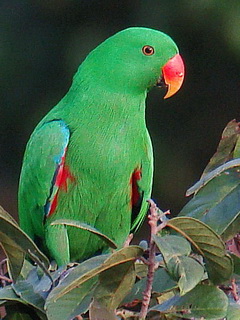 Summary: Easy access and a great introduction to Sulawesi’s birds.\
Key bird species: Maleo; Tabon Scrubfowl; Spot-tailed Goshawk; Bare-faced Rail; Golden-mantled Racquet-tail; Sulawesi Hanging-Parrot; Pygmy Hanging-Parrot; Minahassa Owl; Sulawesi Owl; Ochre-bellied Hawk-Owl; Speckled Hawk-Owl; Sulawesi Nightjar; Sulawesi Kingfisher; Lilac Kingfisher; Green-backed Kingfisher; Scaly Kingfisher; Sulawesi Hornbill; Knobbed Hornbill; Red-bellied Pitta; Rusty-backed Thrush; Sulawesi Myna; White-necked Myna; Finch-billed Myna
Birdwatching locations:
Tangkoko is a really straightforward place to go birding. The closest accommodation options are on the main road as it enters Batu Putih village, and directly opposite them is the entrance track to Tangkoko. The track crosses a stream and then passes through some scrubby forest for 500 m before arriving at the official entrance gate to the park. From here the track continues parallel to the sea for around 2km until it reaches two small buildings (names Post 2 and Post 3). From here the track continues along the coast, but becomes more indistinct, and many trails head inland.
The birding is good all along the entrance track (from the main road to Post 3). Patches or forest along the road hold Rusty-backed Thrush and Green-backed Kingfisher, Finch-billed Myna and the endemic Yellow-billed Malkoha. By night the open grassy areas hold Sulawesi Nightjar, and Sulawesi Scops-Owl is present along the length of the track.
Around the area of Post 2 and Post 3 it is worth exploring into the forest. Here is among the best area for seeing Rusty-backed Thrush, and as you move away from the main coast track and uphill your chances of seeing Lilac Kingfisher, Sulawesi (Dwarf) Kingfisher, Sulawesi Hornbill, Knobbed Hornbill, Red-bellied Pitta and Tabon Scrubfowl increase. It is also in this area that Maleo are occuasionally seen, and on at least one occasions Bare-faced Rail has been recorded.
As you move inland and uphill, towards the roosting trees of the Spectral Tarsiers (which are definitely worth a look!) the forest becomes good for Golden-mantled Racquet-tail, Spot-tailed Goshawk, and more of the birds mentioned above.
By night, a walk around the forest above Post 2 and Post 3 should get you more Sulawesi Scops-Owl and a chance of both Ochre-bellied and Speckled Hawk-Owl. This is also the area that rare and very elusive Minahassa Owl is most commonly seen. If you are lucky the local guides will know of a daytime roost tree, but these change frequently and so your only chance might be a night time chase around listening for the infrequent calls!
For those with a few days at Tangkoko, a day trip (or overnight camping trip) higher on the mountain is interesting. The climb takes around 6-7 hours depending on how fit you are (and how many birds you stop to look at on the way!). Many of the same birds found lower are also present, plus you get a better chance of seeing Sulawesi Myna, the hanging parrots, and on the highest stretches, Scaly Kingfisher. The latter prefers areas dominated by wild ginger, and is usually found perched only 1-2 metres above the ground. They don’t move much, but can be very responsive to calls.
Other side trips that are easy to arrange at Tangkoko include a trip east along the coast to visit a still active Maleo nesting ground. It is probably easier to see Maleo at Tambun, in Bogani National Park, but if you have time here, or you are not planning to visit Bogani, then this at least gives you a chance. A visit to the Maleo site is usually made by boat.
Getting a boat west along the coast is also interesting. For many years now there has been a regular daytime roosting site of Sulawesi Masked-Owl not far from Batu Putih village in a cave on the sea cliffs. It can only be viewed from a boat, but the views are great if you make the trip.
Continuing further west by boat brings you to an area of mangrove that holds the endemic Great-billed Kingfisher. This is a smart looking bird and seeing it makes the trip worthwhile. If you don’t see it here, another good spot for this species is the jetty of the Santika Hotel nearer Manado (directly opposite Bunaken Island, on the main land).
Access and Accommodation:
Getting to Tangkoko is easy. It is about 1.5 hrs drive from the airport, or about 2 hrs from the centre of Manado. By car or taxi take the main road from Manado to Bitung (the port and freight terminal on the eastern tip of North Sulawesi), and just before reaching Bitung turn left at the town of Girian. From there a smaller road snakes its way 20 km north towards the village of Batu Putih. By public transport the route is the same. Catch a bus from Manado to Bitung, and get off at Girian. From there occasional mini-busses run to Batu Putih, but if there is not one there when you arrive and you don’t want to wait, just take an ojek (motorbike taxi).
The most commonly used accommodation options are those that you first meet on the left hand side of the road when you reach Batu Putih (this includes ‘Mama Roo’s’ and ‘Ranger Guest House’). There is another more expensive option, reached by heading into Batu Putih village and turning left along the beach, but it is a bit further from the birding action.
To enter the forest proper at Tangkoko you are usually expected to take a guide (that is to say, they may not let you into the park without one), although if you stick only to the coast track as far as Post 2 you may be allowed in alone. Your accommodation can help you find a guide and negotiate your entrance to the park, or failing that the park staff can assign you a guide at the entrance/ticket gate. Many of the guides at Tangkoko are excellent birders, and many have ‘secret spots’ where they can show you some of the most sought after species.
Guides obtained from the main accommodation options will be up-front about the fees you need to pay (which are not high, but seem to vary from year to year!). They themselves will have to pay the park, so as to avoid the need to be assigned another guide by the park itself, and this will be included in the price. Getting guides assigned by the park at the entrance gate is a bit more random, some are good and some are not, and the fees they charge can vary mysteriously, so better to sort this out from your accommodation!
Most of the guides speak some English, and they can help you arrange trips to the mountain, night birding, or any of the side excursions mentioned above. Just chat through your plans with them and tell them what you want to see (or point at it in a bird book!). //burung-nusantara.org
The nation
of Indonesia stretches along an equatorial archipelago numbering nearly
18,000 islands in total. Encompassing several ecosystem types as well
as straddling the boundaries between the Oriental and Australasian
faunal regions, Indonesia is one of the most biodiverse nations on
Earth.
"Lore Lindu National Park. © Nurlin Djuni"

The high level of biodiversity is amply reflected in Indonesia's
avifauna with 17% of the world's total bird species represented.
1,539 species of which 381 are endemics!
Tremendous scenery of volcanoes, asian rural land, lowland rainforest, wetlands and mangroves and stunning shorelines.
Some facts about Indonesia.
The Republic of Indonesia, is a nation in Southeast Asia. Comprising 17,500 islands, it is the world's largest archipelagic state. With a population of over 200 million, it is the world's fourth most populous country and the most populous Muslim-majority nation, although officially it is not an Islamic state. Indonesia is a republic, with an elected parliament and president. The nation's capital city is Jakarta. The country shares land borders with Papua New Guinea, East Timor and Malaysia. Other neighboring countries include Singapore, the Philippines, Australia, and the Indian territory of the Andaman and Nicobar Islands.
Across its many islands, Indonesia consists of distinct ethnic, linguistic, and religious groups. The Javanese are the politically dominant and largest ethnic group. As a unitary state and a nation, Indonesia has developed a shared identity defined by a national language, a majority Muslim population, and a history of colonialism and rebellion against it. Despite its large population and densely populated regions, Indonesia has vast areas of wilderness that support the world's second highest level of biodiversity. The country is richly endowed with natural resources, yet poverty is a defining feature of contemporary Indonesia.
20x Compact Superzoom Camera with Wi-Fi

What Fujifilm has thrown into the new travel zoom is the Wireless File Transfer capabilities, allowing the camera to send off your files to an Android or iOS device (the Fujifilm Camera Application for Android and the Fujifilm Photo Receiver for iOS) at the push of a button.
All you need to do is download the Fujifilm Photo Receiver app to your device and follow the on-screen instructions to pair your device with the camera. The camera supports the transfer of 30 images per session.
Other than the wireless transfer, the Fujifilm FinePix F800EXR incorporates the same feature set at the F770EXR including the built in film simulation filters along the ability to shoots panoramas and capture images in native RAW. The camera shoots movies in Full HD (30fps) with stereo sound.
The Fujifilm F800EXR also boasts of an impressive 8 frames per second burst mode in full resolution, mighty impressive for a camera in this bracket. The camera incorporates the ability to adjust the flash power, to make sure that the final exposure isn’t overexposed to the flash.
Key Features of Fujifilm FinePix F800EXR
The FinePix F800EXR offers these additional features:
- Intelligent Digital Zoom: With 20x optical zoom, Intelligent Digital Zoom delivers 40x total zoom, and 15x optical zoom extends to 30x total zoom.
- HD Movie Capture: Full 1080p HD quality, a mini HDMI port and stereo sound with a high speed movie option for freezing fast moving action at up to an incredible 320fps.
- Intelligent Image Stabilization: Intelligent Image Stabilization system provides further improved image quality with reduced blurring and noise in still pictures and even when shooting movies at the full optical zoom or in very low-light.
- Amazing panoramic shots: Enhanced Motion Panorama mode that allows users to capture beautiful, seamless 360° panoramic images both horizontally and vertically that show fine detail, low noise and high resolution at 180°, 240˚ or full 360˚ panoramic ranges.
- Tracking Auto Focus (AF): Tracks fast moving subjects so they don’t escape from the frame in a blur. Subjects will be tracked automatically for as long as it is kept in the frame and the shutter is half-pressed; when users fully press the shutter button your subject will be in the centre of the photo in perfect focus.
- Shoot in RAW: Images can also be captured in a RAW file for advanced creative work after shooting.
- Super Intelligent Flash: A flash control system which efficiently controls the level of flash for a given exposure to produce beautifully balanced flash illumination across the foreground and background.
The F800EXR looks to be a fine specimen on paper, but it won’t be out till August and would cost a decent $349.

Among Indonesia’s hundreds of attractions, the government has identified 16 priority destinations to be developed in the coming years, said Minister for Tourism and the Creative Economy, Mari Elka Pangestu recently.
The 16 destinations include Lake Toba in North Sumatra, Pangandaran in West Java, the Borobudur –Prambanan areas in Central Java and Yogya-Sleman in Yogyakarta, the Bromo- Tengger – Semeru area in East Java, Lombok and the Rinjani volcano, Flores in East Nusatenggara, Wakatobi in South East Sulawesi, Toraja in South Sulawesi, Derawan islands in East Kalimantan, besides Pulau Weh in Aceh, the Togean islands in Central Sulawesi, the Thousand Islands and Old Batavia, both in Jakarta., and Bali’s southern and northern coasts, as well as around Mount Batur.
“As a short-term plan, we have picked 16 out of 80 locations as pilot projects on how to manage the tourism sector comprehensively and coordinate with other sectors such as the Public Works Ministry, Transportation Ministry and local governments. The biggest challenge is collaboration with local government. The most extreme case is Lake Toba in North Sumatra because 10 regencies and cities are involved.
In Flores, eight regencies have to team up to develop the island, including Komodo. Improving tourist locations is very difficult if there is no collaboration with locals. This is the real challenge.
Our target is not only to increase the number of tourists visiting our country, but to inspire good quality tourism and make them stay here longer.
Moreover, we need to relate the development of tourist attractions to special interest tourism such as cruise ships, and MICE [meetings, incentives, conventions, exhibitions].
// the Jakarta Post

Don't you believe that land of paradise really exists? It does and you will find it in Bali. Don't wait any longer, just go there. If you want the best for you, your family or your friends during your holiday in Bali, you might think of enjoying any possible comfort and all facilities of a splendid house during your stay.
You may choose the idea of renting a villa to fulfill that dream.
The following information is an insight of Bali, the undoubtedly island of paradise. Bali is one of the 17000 islands belonging to Indonesia, the largest archipelago in the world and considered as one of the most beautiful seaside resorts in Asia. In Bali you will find thousands of kilometers of beaches and great rivers and you will be amazed while exploring this magnificent nature. In fact, you will find all that you want in Indonesia.
Bali is one of the smallest islands of the Indian Ocean and it is highly appreciated by tourists not only due to the luxuriance of its landscape but also to the various choices of accommodation offered to them. Bali will really fascinate you with its terraced rice fields and its lush vegetation that provide the landscape a rare beauty. If there is any risk to take to go there, it will only be the desire to return again to this island.
Actually it is quite rare to find an archipelago with such exhaustive cultural identities where different religions and lifestyles reunite. It will not be possible for you to stay indifferent to this island which has an abundance of arts and cultures.
For example, you may want to stay near the royal palace, in Ubud, to attend the show of the Legong dances as well as to see qualified entertainment every evening at the Art Center in Denpasar. The population is quite friendly and warm. You may be quite sensitive with the hot and humid climate that reigns over Bali all year long.
The coast has idyllic beaches of white sands or volcanic and it has many diving spots with sea bottom enriched by fishes and corals. Bali Traditions in Bali Accomodation in Bali Rent a villa in Bali Travel agents in Bali Rental fee in Bali Holiday in Bali Going for holiday Choices of staying Souvenirs of Bali To go to Bali Examples of stay
Wandering about the City
Macau has earned the title of the Oriental Las Vegas as it is a gamblers' paradise, however, it is also a beautiful city with clear streets, gardens and picturesque hilly landscapes. A wander around the city is a fantastic experience!
The inner city area of Macau is ideally suited for exploration on foot and there is much to discover in the many winding streets to be found close to the main square, Largo do Senado in the downtown or along the waterfront avenues in the southern part of the city near Nam Van or Outer Harbor. We can recommend this and feel confident that no one would be disappointed.
 |
| Macau at Night |
On Guia Hill in the eastern part of the Macau Peninsular and the hills of the outlying islands of Taipa and Coloane, there are winding trails with exercise equipment along the roadside for those who like to jog. Hiking among the hills affords panoramic views of the city, harbors and the natural landscape of the surrounding islands. A cable car service is available from 7:30 to 18:30 each day on Guia Hill. The single trip costs three Patacas while a return ticket costs five Patacas for the round trip.
Taipa and Coloane are good choices for those who like cycling. Bicycles can be rented on Taipa, from the garage next to the Civic and Municipal Affairs Bureau building (close to the Tin Hau Temple and bus terminal).
Another unique way to tour the area is to travel on the nine-seated replica of a 1920's London bus. This splendid vehicle is chauffeur-driven. It follows a scheduled route around the city and a tour lasts approximately two hours. The fare is MOP$300 per person, however special tours may be arranged when the cost will be doubled.
Golf
Macau has the most beautiful golf course in Asia. The Macau Golf & Country Club is located on the south side of Coloane Island and near the Western Resort Complex. Here the excellent golfing facilities are complimented by fine views of the landscape over the Pearl River and Hac Sá beach.
Karting
As a beforehand racing car of F-1, Karting is favored by the many car racing lovers who are fascinated in the Macau Grand Prix, a well-known international formula 3 game held in the city. It is much easier to drive and participants are not necessarily required for licenses.
At the southern end of the causeway linking Taipa with Coloane is a karting circuit. The track is wide enough for about 30 cars racing at the same time. The complete facilities of a stand with the capacity of 2,500 people, time equipment, living broadcast screens, show halls, restaurants and special racing courts for children are provided. Foreign karting lovers and locals alike come Getting there: Bus 21, 21A or 25 can take you there.
Horse& Greyhound Racings
Horse racing and dog racing are two of the alternatives for those who do not want to go to casinos. The Macau Jockey Club, located in the south-east coastal area of the outlying island of Taipa has a cosmopolitan group of trainers, riders and horses imported from several countries. The racing season is from September to August next year. Public buses to Jockey Club include 11, 15, 22, 28A, 30, 33, 34, 35 & AP1.
Dog racing was introduced here in 1960 and has become a firm rival to the horse races. It has been said that bets totaling over 150,000 MOP$ are placed at any one time. The dog track is at the Canidrome located at Avenida General Castelo Branco. There are around 15 races on every racing night starting from 7:30 p.m. Admission is MOP$10 for the public stand. You can take public buses of 1, 1A, 3, 4, 5, 7, 9, 9A, 23, 25, 26, 26A, 32, 33 and 34 to get there. The website of Canidrome (Macau dog racing) is www.macauyydog.com.
 Enthralling Nightlife
 |
| Stores |
Gambling
With casinos to rival both Monte Carlo and Las Vegas, gambling accounts for almost 50% of the government revenue and forms the backbone of the city's tourist economy. Gambling casinos throughout the city are inevitably packed with people from all over the world who come to seek their fortunes.
The numerous Casinos are extravagantly bedecked with dazzling chandeliers, luxurious gaming rooms and first-class hotel facilities add to the glitz of nighttime Macau. Thousands of frenetic gamblers swarm into these venues for 24 hours to seek their fortunes. Most of the best known casinos are housed in top-class hotels in the Macau Peninsular and the island of Taipa. The flagship casinos include Hotel Lisboa Casino, Macau's first Las Vegas-invested casino Sands Macau, Galaxy Waldo Casino and Macau Palace Casino. The tables include roulette, blackjack and poker; of course there are the ever popular slot-machines as well. There are in addition local games such as Chinese fan-tan to give visitors and locals alike sound reasons for visiting in order to experience first hand the height of luxury and excitement.
Hotel Lisboa in a large bird-cage building is the king among these venues. The façade entrance is designed like the big mouth of a tiger and on the lobby dome there is a heart with numerous prickles to symbolize the punishment of gamblers' greed. However, such warnings are formalities and are heeded by many with the same degree of nonchalance as the SMOKING KILLS warning on a packet of cigarettes!
The showy 'Crazy Paris Dancing' performed by charming hostesses in Hotel Lisboa and presented at 20:00 and 21:30 from Monday to Friday is the best choice for those who enjoy watching dancing.
Public buses of 3, 3A, 8, 10, 10A, 10B, 12, 22, 23, 25, 28A, 28BX, 28C, 32 reach the casino.
 |
| Casino & Hotel Lisboa |
The casinos accept only Hong Kong dollars and Macau Patacas and guests can exchange money either at casino counters or the nearby banks.
 Casinos in Macau Peninsular
Lisboa Casino
Address: Avenida de Lisboa, No. 2-4, Hotel Lisboa
Galaxy Waldo Casino
Address: Avenida de Amizade, Waldo Hotel
Sands Macau
Address: Avenida de Amizade
Macau Palace Casino
Address: Avenida de Amizade
Mandarin Oriental Casino
Address: Avenida de Amizade, No. 956-1110, Mandarin Oriental Macau
Pharaoh's Palace Casino
Address: Avenida de Amizade, No. 555, 3 andar, The Landmark, Macau
Diamond Casino
Address: Rua de Pequim, No. 82-86, Hotel Holiday Inn Macau
Jai Alai Casino
Address: Est. da Pelota Basca
Kam Pek Casino
Address: Rua de Foshan, Centro Comercial San Kin Yip, 1 andar
Casinos in Taipa |
| Casino in Macau |
Address: Estrada Governador Albano de Oliveira, No. 142, Grandview Hotel, Taipa
Mandarin Oriental Casino
Avenida de Amizade, No. 956-1110, Mandarin Oriental Macau, Macau
Marina Casino
Address: Aterro COTAI, Marina de Taipa Sul, Pousada Marina Infante, Taipa
Night WalkingFor those who are seeking a money-saving choice of nightly entertainment, a stroll around those parts of the city that are very busy by day can leave you with unique impressions. The popular destinations include the main square, Largo do Senado, Ruins of St. Paul's, Clube Militar de Macau and Macau Houses Museum.
Bars& DiscosApart from the gambling venues, all sorts of gracefully decorated lounge bars and hotel bars and arrays of sidewalk cafes and bars featuring grazioso Latin and African style music provide more choices for locals. The two famous bar and dining streets in the city are located close to the main square, Largo do Senado in the heart of the city and along Avenida Dr. Sun Yat-sen near the Kun Iam Statue in the south reclaimed-land of Outer Harbor.
Bar Street near Avenida Dr. Sun Yat-sen
At the end of Dr.Carlos D'Assumpcao Park in the southern reclaimed-land of Outer Harbor is an avenue called Avenida Dr. Sun Yat-sen. Thanks in part for the waterfront position, this area has become a bustling nighttime entertaining center. Crowds of people go there both for a drink and live performances as well as the charming night scene of outlying islands. All sorts of bars and pubs, cafes, restaurants and food shops line the street sidewalk and music bands and dance groups present live performances for guests.
Getting there: Bus 1A, 8, 12, 17 and 23
Fishman's Wharf
A prime amusement attraction in Macau is called Fishman's Wharf. This was initiated by the Macau amusement magnate, Macao Tourism and Amusement Company. It is undergoing its final construction phase and will open to the public in December this year. With an area of over one million square feet, this entertainment complex boasts that it will be a new experience with buildings in a variety of exotic western and oriental architectural styles. It combines entertainment, shopping, restaurants, hotels, docks and convention facilities in one place with driveways and parking for both bus and taxi.
The wharf entertainment area is planned to be built in the waterfront reclaimed area between Sands Macau and Macau Palace, two famous casinos in the city along Avenida de Amizade in the New Reclaimed Area. Buses 1A, 3, 3A, 10, 10A, 10B, 12, 17, 23, 28A, 28B, 28Bx, 28C, 32 and API can take you to Immigration Office of Macau, which opposites the Macau Palace casino.
Bar Street in Downtown
Rua S. Domingos is a street located north to the main square, Largo do Senado in the central downtown. This is the busiest area and is packed with restaurants, local snack shops, clothes shops to name but a few. Various bars and cafes along these streets provide delicious Macau snacks and a pleasant environment.
Disco parlors with popular Chinese, Cantonese and Thai music and songs can be found easily in the city. People usually spend the evening at these parlors with friends until late into the night. The reasonably-priced Kara-ok entertainment is very popular with young people.
Cinemas & Theaters
Macau is also a venue for both Western and Oriental arts and culture. Cinemas and theaters in the city provide films, operas, musical performances and other entertainments. For those who want to get to know the city in depth, D.Pedro V Theatre located a little southwest of the busiest downtown AV. Almeida Ribeiro and the theatre in Macau Tower Convention& Entertainment Center in the reclaimed area at the very tip of the Macau Peninsular are two good places. Buses 23 and 32 can take you to the tower.
Gallery
-
Best Western Vega Hotel The tourist BEST WESTERN Vega Hotel & Convention Center is a part of the biggest Europea...
-
 Zhangye Danxia Landform is focused predominantly in Linze and Sunan counties in Gansu Province. it's each the biggest and therefore the...
-
 Cosmopolitan and polished, Singapore is one of Southeast Asia's most glamorous capitals, functioning as a high-traffic travel hub and...
-
Are you prepared to eat "balut" -- ducks egg, bagoong -- shrimp paste, fish sauces and taste some tropical produce? Let u...
-
The main Tourist Information Center (TIC) is located on the basement level of the Korea Tourism Organization (KTO) headquarters in Seoul. ...


