


Showing posts with label Indonesia. Show all posts
 Tana toraja is quite simply unique. A cultural island, hemmed in by mountains on all sides, the toraja prove there is life after death with their elaborate ceremonies. Take the beauty of Bali, the houses of the Bataks in Sumatra and the megalithic cultures of Sumba and you’re still not even close. Cave graves, hanging graves, tau tau (life-sized wooden effigies) of the dead and buffalo carnage every summer; it’s macabre but mesmerising.
This is a world unto itself.
Tana toraja is undoubtedly the most popular destination in Sulawesi. It’s a vast, pretty and mostly unspoilt area of traditional villages, unique architecture and fascinating cultures. The funeral season is usually during July and August, when toraja working throughout Indonesia return home for celebrations, tourists come in numbers and Rantepao hotel prices peak.
The Burial Ceremony
 Most Tana Torajans are Chirstian while still retaining their traditional norms and customs. If someone dies, his or her body will be kept inside the house for days, sometimes weeks or even months. The body is well treated and preserved by using cetain herbs. The purpose of keeping the body are to give a chance to the family of the deceased to gather and collect money. Once the fund is enough to hold a necessary ceremony, the ritual begins.
From the Torajan's point of view, however, life starts from and ends in heaven. Thus, there are two most important events in human life-birth and death. In this case, to properly reach heaven means to have proper burial, which in turn means to provide as many buffalos and pigs as possible.
On the burial ceremony, they leave the corpse inside a cave. Many visitor would surprise of not smelling any strong odor that usually comes with a corpse. Oral history says taht in the old days, the deceased would be "ordered" by a shaman to walk by him or herself to the cave. It was a zoombie-like procession. Unfortunately no one can witness this kind of ritual today.
The most spectacular of Torajan rituals are the funerals. For Torajan, a funeral is the single most important ceremony in the life cycle. It is based on a strong belief that the soul of the deceased travels to the land of the south and in this land of eternity, he will need all the requisites of everyday life in the hereafter just like when he was alive in this world. Funeral ceremonies are festival lasting as long as ten days with much feasting and entertainment. Animal sacrifices are made to ensure eternal life in the afterlife and to safeguard the descendants.
 Electricity & Water
Indonesia runs 127V AC/50Hz but is in the process of converting to a 230V AC/50Hz. This conversion is complete in principal cities. Indonesia uses a type C,F, and G plug so North Americans travelling with electronics will need adapters.
It is not advisable to drink tap water in Indonesia, but bottled mineral water is safe and available everywhere. Ice in drinks is generally OK in good standard hotels and restaurants but it is best to avoid it on street stalls or in country areas.
Clothing
With temperatures ranging between 20-35�C, light, casual clothes are the most practical. Natural fibres like cotton or linen are the most comfortable in Indonesia's often humid conditions. Casual clothes are acceptable in most places and a lightweight suit and tie are usual for business or formal meetings. Light cotton dresses are generally acceptable in most situations. Batik is popular for both men's shirts and women's dresses.
Communications
Telephone
IDD is available to main cities. Country code: 62 (followed by 22 for Bandung, 21 for Jakarta, 61 for Medan and 31 for Surabaya). Outgoing international code: 00. Many hotel lobbies have public phones which take credit cards and phone cards. For emergencies, dial 110 (police) or 118 (ambulance for traffic accidents) or 119 (ambulance for general health) or 113 (fire department).
Mobile telephone
GSM 900 and 1800 networks. Coverage may be limited to main towns and cities.
Fax
Faxes can be sent and received from WARTEL shops.
Internet
There are Internet cafes in all major cities and tourist destinations.
Telegram
These can be sent from any telegraphic office; in Jakarta facilities are available 24 hours a day, but services outside Jakarta are less efficient.
Post
Airmail to Western Europe takes up to 10 days. Internal mail is fast and generally reliable by the express service (Pos KILAT), but mail to the outer islands can be subject to considerable delays.
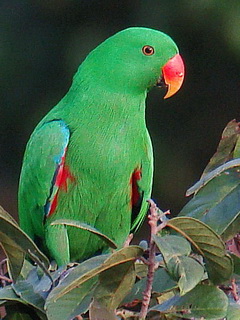 Summary: Easy access and a great introduction to Sulawesi’s birds.\
Key bird species: Maleo; Tabon Scrubfowl; Spot-tailed Goshawk; Bare-faced Rail; Golden-mantled Racquet-tail; Sulawesi Hanging-Parrot; Pygmy Hanging-Parrot; Minahassa Owl; Sulawesi Owl; Ochre-bellied Hawk-Owl; Speckled Hawk-Owl; Sulawesi Nightjar; Sulawesi Kingfisher; Lilac Kingfisher; Green-backed Kingfisher; Scaly Kingfisher; Sulawesi Hornbill; Knobbed Hornbill; Red-bellied Pitta; Rusty-backed Thrush; Sulawesi Myna; White-necked Myna; Finch-billed Myna
Birdwatching locations:
Tangkoko is a really straightforward place to go birding. The closest accommodation options are on the main road as it enters Batu Putih village, and directly opposite them is the entrance track to Tangkoko. The track crosses a stream and then passes through some scrubby forest for 500 m before arriving at the official entrance gate to the park. From here the track continues parallel to the sea for around 2km until it reaches two small buildings (names Post 2 and Post 3). From here the track continues along the coast, but becomes more indistinct, and many trails head inland.
The birding is good all along the entrance track (from the main road to Post 3). Patches or forest along the road hold Rusty-backed Thrush and Green-backed Kingfisher, Finch-billed Myna and the endemic Yellow-billed Malkoha. By night the open grassy areas hold Sulawesi Nightjar, and Sulawesi Scops-Owl is present along the length of the track.
Around the area of Post 2 and Post 3 it is worth exploring into the forest. Here is among the best area for seeing Rusty-backed Thrush, and as you move away from the main coast track and uphill your chances of seeing Lilac Kingfisher, Sulawesi (Dwarf) Kingfisher, Sulawesi Hornbill, Knobbed Hornbill, Red-bellied Pitta and Tabon Scrubfowl increase. It is also in this area that Maleo are occuasionally seen, and on at least one occasions Bare-faced Rail has been recorded.
As you move inland and uphill, towards the roosting trees of the Spectral Tarsiers (which are definitely worth a look!) the forest becomes good for Golden-mantled Racquet-tail, Spot-tailed Goshawk, and more of the birds mentioned above.
By night, a walk around the forest above Post 2 and Post 3 should get you more Sulawesi Scops-Owl and a chance of both Ochre-bellied and Speckled Hawk-Owl. This is also the area that rare and very elusive Minahassa Owl is most commonly seen. If you are lucky the local guides will know of a daytime roost tree, but these change frequently and so your only chance might be a night time chase around listening for the infrequent calls!
For those with a few days at Tangkoko, a day trip (or overnight camping trip) higher on the mountain is interesting. The climb takes around 6-7 hours depending on how fit you are (and how many birds you stop to look at on the way!). Many of the same birds found lower are also present, plus you get a better chance of seeing Sulawesi Myna, the hanging parrots, and on the highest stretches, Scaly Kingfisher. The latter prefers areas dominated by wild ginger, and is usually found perched only 1-2 metres above the ground. They don’t move much, but can be very responsive to calls.
Other side trips that are easy to arrange at Tangkoko include a trip east along the coast to visit a still active Maleo nesting ground. It is probably easier to see Maleo at Tambun, in Bogani National Park, but if you have time here, or you are not planning to visit Bogani, then this at least gives you a chance. A visit to the Maleo site is usually made by boat.
Getting a boat west along the coast is also interesting. For many years now there has been a regular daytime roosting site of Sulawesi Masked-Owl not far from Batu Putih village in a cave on the sea cliffs. It can only be viewed from a boat, but the views are great if you make the trip.
Continuing further west by boat brings you to an area of mangrove that holds the endemic Great-billed Kingfisher. This is a smart looking bird and seeing it makes the trip worthwhile. If you don’t see it here, another good spot for this species is the jetty of the Santika Hotel nearer Manado (directly opposite Bunaken Island, on the main land).
Access and Accommodation:
Getting to Tangkoko is easy. It is about 1.5 hrs drive from the airport, or about 2 hrs from the centre of Manado. By car or taxi take the main road from Manado to Bitung (the port and freight terminal on the eastern tip of North Sulawesi), and just before reaching Bitung turn left at the town of Girian. From there a smaller road snakes its way 20 km north towards the village of Batu Putih. By public transport the route is the same. Catch a bus from Manado to Bitung, and get off at Girian. From there occasional mini-busses run to Batu Putih, but if there is not one there when you arrive and you don’t want to wait, just take an ojek (motorbike taxi).
The most commonly used accommodation options are those that you first meet on the left hand side of the road when you reach Batu Putih (this includes ‘Mama Roo’s’ and ‘Ranger Guest House’). There is another more expensive option, reached by heading into Batu Putih village and turning left along the beach, but it is a bit further from the birding action.
To enter the forest proper at Tangkoko you are usually expected to take a guide (that is to say, they may not let you into the park without one), although if you stick only to the coast track as far as Post 2 you may be allowed in alone. Your accommodation can help you find a guide and negotiate your entrance to the park, or failing that the park staff can assign you a guide at the entrance/ticket gate. Many of the guides at Tangkoko are excellent birders, and many have ‘secret spots’ where they can show you some of the most sought after species.
Guides obtained from the main accommodation options will be up-front about the fees you need to pay (which are not high, but seem to vary from year to year!). They themselves will have to pay the park, so as to avoid the need to be assigned another guide by the park itself, and this will be included in the price. Getting guides assigned by the park at the entrance gate is a bit more random, some are good and some are not, and the fees they charge can vary mysteriously, so better to sort this out from your accommodation!
Most of the guides speak some English, and they can help you arrange trips to the mountain, night birding, or any of the side excursions mentioned above. Just chat through your plans with them and tell them what you want to see (or point at it in a bird book!). //burung-nusantara.org
The nation
of Indonesia stretches along an equatorial archipelago numbering nearly
18,000 islands in total. Encompassing several ecosystem types as well
as straddling the boundaries between the Oriental and Australasian
faunal regions, Indonesia is one of the most biodiverse nations on
Earth.
"Lore Lindu National Park. © Nurlin Djuni"

The high level of biodiversity is amply reflected in Indonesia's
avifauna with 17% of the world's total bird species represented.
1,539 species of which 381 are endemics!
Tremendous scenery of volcanoes, asian rural land, lowland rainforest, wetlands and mangroves and stunning shorelines.
Tremendous scenery of volcanoes, asian rural land, lowland rainforest, wetlands and mangroves and stunning shorelines.
Some facts about Indonesia.
The Republic of Indonesia, is a nation in Southeast Asia. Comprising 17,500 islands, it is the world's largest archipelagic state. With a population of over 200 million, it is the world's fourth most populous country and the most populous Muslim-majority nation, although officially it is not an Islamic state. Indonesia is a republic, with an elected parliament and president. The nation's capital city is Jakarta. The country shares land borders with Papua New Guinea, East Timor and Malaysia. Other neighboring countries include Singapore, the Philippines, Australia, and the Indian territory of the Andaman and Nicobar Islands.
The Republic of Indonesia, is a nation in Southeast Asia. Comprising 17,500 islands, it is the world's largest archipelagic state. With a population of over 200 million, it is the world's fourth most populous country and the most populous Muslim-majority nation, although officially it is not an Islamic state. Indonesia is a republic, with an elected parliament and president. The nation's capital city is Jakarta. The country shares land borders with Papua New Guinea, East Timor and Malaysia. Other neighboring countries include Singapore, the Philippines, Australia, and the Indian territory of the Andaman and Nicobar Islands.
Across its many islands, Indonesia consists of distinct ethnic, linguistic, and religious groups. The Javanese are the politically dominant and largest ethnic group. As a unitary state and a nation, Indonesia has developed a shared identity defined by a national language, a majority Muslim population, and a history of colonialism and rebellion against it. Despite its large population and densely populated regions, Indonesia has vast areas of wilderness that support the world's second highest level of biodiversity. The country is richly endowed with natural resources, yet poverty is a defining feature of contemporary Indonesia.

Located at the westernmost of Flores (the capital of West Manggarai Regency in East Nusa Tenggara) Labuan Bajo was formerly known as a fisherman village. Today, it is a tourism destination not less popular and exotic than Bali. Day by day, more tourists come to Labuan Bajo to see the giant lizard (Komodo), continue their trip to Kelimutu Lake and Maumere. Statistics reports 115% tourist arrival increase from 2005 to 2011. In addition to the three most popular tourism attractions, Labuhan Bajo offers Mirror Stone Cave, Lake Sano Nggoang, Caci dance, and many more cultural beauties.

"As Komodo National Park gets more popular, other tourism attractions in Labuan Bajo are expected to also become more widely-known and developed and East Manggarai people will benefit from this,” said Minister Mari Elka Pangestu at her work visit to Labuan Bajo, 20 July 2012.

The development of Labuan Bajo tourism cannot be separated from the development of Flores as a whole. Flores is one of the tourism development priorities in the Acceleration and Expansion of Indonesia Economic Development (MP3EI) Corridor 5, as a “Gateway for Tourism and National Food Support”. Flores is among the 16 tourism destination priorities with diving as one of its seven special interest tourisms to be developed.


The tourism development of Labuan Bajo in particular, and Flores in general, is carried out through the Destination Management Organization (DMO), a program run by Ministry of Tourism and Creative Economy aiming at improving the quality and competitiveness of Indonesia tourism destinations. In its implementation, DMO involves tourism business, community leaders, education sector and all stakeholders to work together with local and central government. Flores DMO is divided into 8 Tourism Management Organization (TMO).
During her work visit to Labuan Bajo, Minister Mari Elka Pangestu witnessed the MoU signing between TMO of Labuan Bajo and the government of West Manggarai Regency to jointly develop Labuan Bajo as a world-class tourism destination. "The most important thing is the commitment of local government, central government, relevant agencies and all stakeholders regarding its implementation," said Mari.

Minister also spent time to visit the English language training in SMKN I Komodo organized by Mandiri Bank as part of its CSR program. "It is a very good program and it should be carried out as early as possible in order to prepare the needs and challenges of human resources competitive in hospitality industry for the next four or five years in Labuan Bajo," said Mari.(Center of Public Communication)
//budpar.go.id

Explore the last frontier of Indonesia’s remote Papua Island, embark on a spectacular cultural journey and attend theBaliem Valley Festival scheduled to take place from 8th-11th August this year.
This is the one occasion when all the diverse tribes from the highlands of Wamena and the Baliem Valley such as the Dani, Lani, and the Yali congregate to celebrate their annual festival. This year the festival will be held at Wosilimo, the Usilimo, area in the district of Jayawijaya.
Located high in the Jayawijaya mountains on the Indonesian side of the island of New Guinea, Baliem is a stunningly beautiful green valley long hidden beyond soaring hills.
Highlight of the Festival is the mock tribal warfare held to maintain the agility and preparedness of the tribes to defend their villages.
To prepare for these mock battles, organizers have prepared an arena of 400m by 250m that will be filled with 500 to 1000 of warriors and dancers.
The tribal war simulation is scheduled to be held during two days featuring about 26 groups of 30-50 warriors. These mock battles are accompanied by the Papuan traditional music of Pikon. Pikon is a musical instrument made out of wood skin which produces sounds when one blows it. The sounds created produce soothing music. Not many people can play the instrument as it requires special skills.
Organized by the district government of Jayawijaya, the festival is aimed to introduce and preserve the values and culture of Baliem Valley’s traditional tribes. The Baliem Valley festival will be enhanced by various fascinating art and cultural performances, including traditional Papuan dances, pig racing, Puradan Rattan Spear Throwing, Sikoko Spear games, Papuan traditional musical performance, and many more.
There will also be a special competition of Sege throwing and archery competition for foreign visitors as a sign of appreciation for their attendance. Visitor can also experience the true meaning of being a Papuan by wearing the traditional costumes of Koteka and have their skins blackened so they can also be part of the festivities.
Join the crowd and learn what makes them smile, laugh, and cheer. The Baliem Valley Festival 2011 awaits, offering abundant memories of the magical land of Papua.
To reach Baliem Valley fly to the town of Wamena via Jayapura. There are regular flights available to Jayapura from Jakarta and Makassar. To attend the Festival it is best to contact an experienced travel agent. For complete information on the Baliem Valley, including flights, operators, how to get there, where to stay, and what to do, you can visit our: Baliem Valley : Home of the Dani
//indonesiatravel

This summer, the hill town of Tomohon in North Sulawesi will spring into full bloom when the Tomohon International Flower Festival gets underway from 8 – 12 August. Highlight of the Event is the Tournament of Flowers parade, which will bel participated by a number of Indonesian provinces as well as overseas participants, government enterprises, 15 districts in the province itself, as also private companies. Carrying the theme: “Wonderful Tomohon”, the Tomohon International Flower Festival Is expected to be watched by over 30,000 people.
There will be four main components at the Festival, said Tomohon mayor, Jimmy F. Eman at the press Conference held at the Miinistry of Tourism and Creative Economy, witnessed by Deputy Minister,Sapta Nirwandar. These components include: the Tournamenf of Flowers, to be held on 8 August; the Queen of Flowers pageant, on 10 August; the Tourism, Trade, Investmentand Florikultura Exhibition to be held from 8 – 12 August, as well as a Cultural Festival from 9 – 12 August.
The Agricultural Office said that there will be a total of 3 million flowers provided by the 42 agricultural groups in Tomohon to be displayed during the Festival, used by participants and decorate the town, among which flowers are its main produce of fresh carnations and chrysanthemums.
The Tomohon International Flower Festival is held every two years since 2008. In the first year, participants included 46 cities in Indonesia while the Festival was watched by 20,000 people. In 2010, some 82 floats participated, including those fromi Malaysia, Vietnam, North Korea, India, and Russia. In this second Event the Festival was watched by 25,000 persons.
Facing two active volcanoes, the Lokon and the Mahewu, the cool hill resort of Tomohon lies 24 km south of Manado, capital city of North Sulawesi, on the way to pleasant Lake Tondano.
Because of its constant cool climate and fertile soil, Tomohon has grown into North Sulawesi’s main producer of vegetables and flowers. When flowers are in bloom, Tomohon becomes a pretty town where almost every house displays colorful fresh flowers. Here are also many seminaries and religious schools of a number of Christian denominations. Most famous among its landmarks is the “Bukit Inpirasi” or “Inspiration Hill”, where communities congregate to seek inspiration for solutions amidst life’s problems.
The Tomohon International Flower Festival is supported by the Ministry of Tourism and Creative Economy.
For more information, please open: http://tiff2012.tomohon.info/
//indonesiatravel
Gallery
-
Best Western Vega Hotel The tourist BEST WESTERN Vega Hotel & Convention Center is a part of the biggest Europea...
-
 Zhangye Danxia Landform is focused predominantly in Linze and Sunan counties in Gansu Province. it's each the biggest and therefore the...
-
 Cosmopolitan and polished, Singapore is one of Southeast Asia's most glamorous capitals, functioning as a high-traffic travel hub and...
-
Are you prepared to eat "balut" -- ducks egg, bagoong -- shrimp paste, fish sauces and taste some tropical produce? Let u...
-
The main Tourist Information Center (TIC) is located on the basement level of the Korea Tourism Organization (KTO) headquarters in Seoul. ...


